Father of the Bride Speech Examples That Actually Work (Why They Land)
Three real father of the bride speeches from TikTok, broken down move by move.
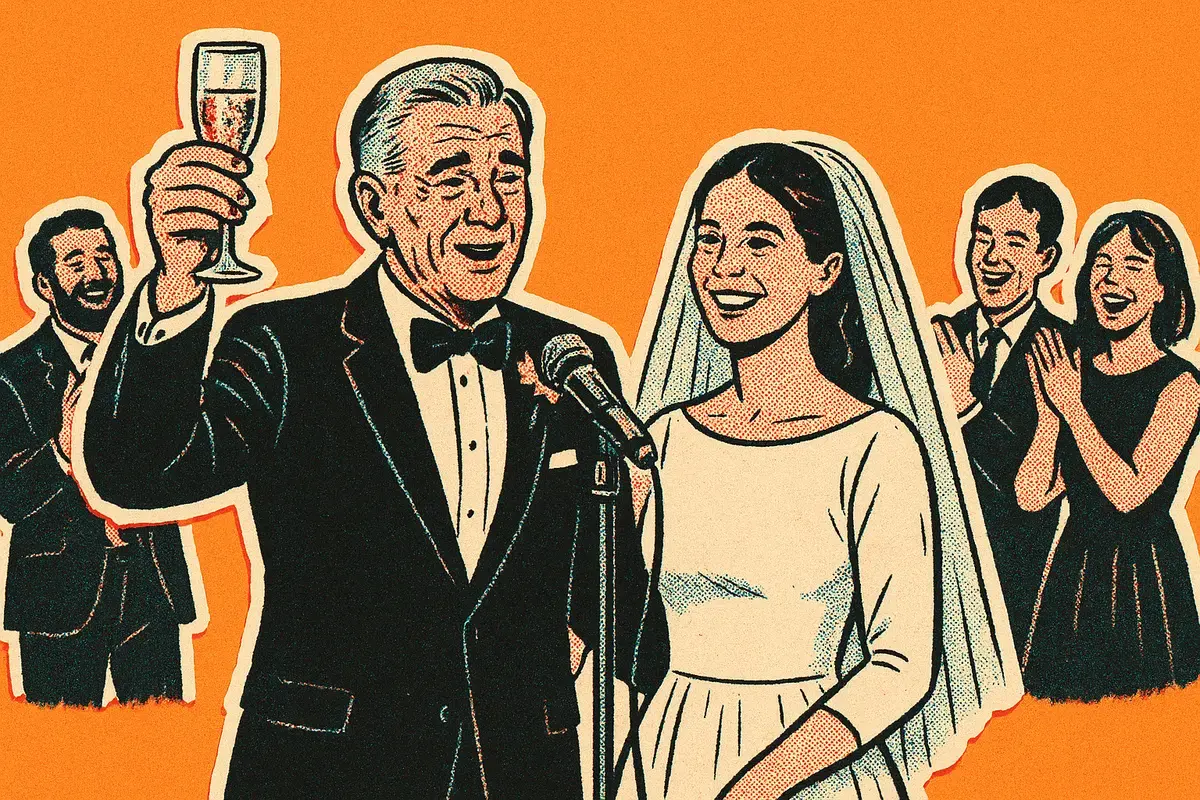
Search "father of the bride speech examples" and you'll find two kinds of results. Template scripts full of stiff, formal lines that sound like they were written in 1985. And TikTok clips of dads whose speeches made the whole room laugh, then reach for a napkin.
The template ones are safe and forgettable. The TikTok ones are the reason a daughter keeps the video on her phone forever.
This article is about the second kind. We've pulled three real father of the bride speeches from TikTok and broken down exactly what each one is doing — the move it pulls, the beat that lands it, and what you can steal for your own.
This isn't "speak from the heart" advice. Every father of the bride speech that works is doing something concrete. Once you can see the moves, you can use them.
Three things every great father of the bride speech gets right
Before the examples, the short version of what separates the speech that gets a standing ovation from one the room politely claps through.
- Pride, said plainly. You have an advantage no one else at the wedding has — you're the proud dad. The best speeches don't dress it up; they just let it show.
- A welcome that can have a wink. The line to your new son- or daughter-in-law doesn't have to be solemn. Humor welcomes them into the family just as warmly.
- The room takes its cue from you. It's traditionally the first speech of the day. If you let the emotion land instead of fighting it, the whole room lands with you.
All three clips below are doing one of these better than almost anyone. Here's how.
Example 1: The classic — pride, plainly delivered
What's happening. The videographer captioned this one simply: "A Father's Speech." No hook, no gimmick — just a dad at the microphone doing the oldest job at the wedding. And it's worth studying precisely because it isn't trying to be clever. It's a father being proud of his daughter, out loud, in front of everyone who matters to her.
Why it works. The father of the bride speech has one structure that never fails, and it's the one most stiff template speeches throw away: then and now. You are the only person in the room who remembers her at five, at fifteen, and today. One vivid memory of her as a child, set against the woman in the white dress, does the emotional work for you — the room does the math. The reason "a father's speech" lands without any tricks is that the pride is real and the relationship is the oldest one in the room.
The mistake is hiding that pride behind formality — "it gives me great pleasure to…" The room can hear the costume. The dads who land it talk the way they'd talk to her at the kitchen table.
What to steal. Finish this out loud: "I still remember when she…" Tell that one story, with real detail, then say the line that brings it to today — "and now she's standing here." That contrast is your whole speech. Say it the way you'd actually say it, not the way you think a speech is supposed to sound.
Example 2: The welcome, with a wink
What's happening. This dad welcomes his new son-in-law with a running joke — advice to "treat the wife like a new car," extended into clutch, service, and gears gags. The caption says it all: "Father of bride gives advice to his new son in law." It's a bit, and it lands.
Why it works. Every father of the bride speech has a line about the new partner. Most are generic — "welcome to the family, we're so happy to have you." Fine, and forgettable. This dad does something smarter: he turns the welcome into the funniest part of the speech. The humor isn't a detour from the warmth — it is the warmth. A dad who's relaxed enough to rib his new son-in-law is a dad who's genuinely happy about the marriage, and the whole room reads it that way.
It works because the joke is affectionate and it's aimed in the right place — at the marriage, playfully, never at the bride. An extended metaphor like "treat her like a new car" also gives the audience a runway: they see where it's going and enjoy watching him get there.
What to steal. Your welcome doesn't have to be solemn. If you've got a joke in you — one that's warm and pointed at the right target — make the welcome the laugh of the speech. A father who can tease his new son- or daughter-in-law is telling the whole room he approves, without having to say it.
Example 3: When you just let it land
What's happening. The videographer set this one to "To Build A Home" — the song you reach for when something is going to make people cry — and captioned it with a single word: "This." That's a filmmaker telling you everything with restraint. This is the emotional father-of-the-bride speech, the one that gets to him and gets the room.
Why it works. The end of a father of the bride speech is the part everyone is secretly watching for — will he get through it? And here's the thing the best ones understand: you don't have to. The slight crack in the voice, the pause that's a half-beat too long, the moment he has to gather himself — that is the speech. The room isn't hoping you stay composed; it's hoping you mean it. A father fighting the emotion reads as guarded. A father letting it land reads as love.
The craft is in placement, not suppression. Put the most emotional line at the very end, right before the toast — not buried in the middle — and let it be what it is. A small laugh earlier in the speech keeps you (and the room) steady enough to spend it all on the landing.
What to steal. Decide your last line first, and make it the most honest sentence you've got — to her, or about her. Don't armor it with formality. When it gets to you, let it. The toast that lands through a few tears is the one she replays for the rest of her life.
The reusable framework
Across the three, the craft of a father of the bride speech reduces to three pillars:
- Lead with pride, plainly. Use then-and-now — one childhood memory, then the turn to today — and say it the way you'd say it at home, not in a costume.
- Let the welcome have a wink. A warm, well-aimed joke welcomes the new partner better than any formal line. If you've got the humor, spend it here.
- Let the emotion land. Put the most heartfelt line at the end, deliver it slowly, and don't fight the lump in your throat. The room is there for exactly that.
Everything else — the housekeeping, the thank-yous to the venue, the "on behalf of" formalities — is optional and usually too long. Trim it hard.
What not to do (two common fails)
Fail 1: The formal address. Stiff, ceremonial language that sounds nothing like how you actually talk to your daughter. "It gives me great pleasure to…" The room can hear the costume. Fix: say it the way you'd say it to her at the kitchen table.
Fail 2: The history lecture. A decade-by-decade account of her life, every school, every job, every house move. It's a timeline, not a speech. Fix: cut it to the one or two moments that actually show who she is.
A note on writing vs. talking your speech
One thing worth flagging. Watch those clips with the captions off and you'll notice the dads who land it sound like they're talking, not reading — the rhythm of a father telling a story, with pauses and warmth, not a script.
That's almost impossible to fake by typing at a blank page. Typing makes you sound formal and stiff — exactly the trap father of the bride speeches fall into, and one of the reasons most AI wedding speeches feel generic. They're built from typed prompts that never sounded like a real voice.
If you want your speech to sound like you, start by speaking it. Record a voice note talking about your daughter: the memory, the welcome, the thing you most want to say to her. Don't script it. Just talk. Then shape that into a speech — or let a tool built for exactly this job do the shaping for you.
Try this before you write a single line
Twenty minutes, no writing required. Open your phone's voice recorder and answer these three prompts out loud, one at a time:
- The memory. Tell one specific story of her as a child that still makes you smile, then the line that brings it to today.
- The welcome. Say something to her new partner — and if a warm joke comes out, keep it.
- The last line. Say the most honest sentence you'd want to land on, just before the toast. Don't tidy it up.
Stop recording. That's the spine of your speech. Everything else is runway.
When you're ready to turn it into something you can stand up and deliver, start with your voice, not a blank page.
Ready to try talk-first speech writing?
Skip the blank page. Speak your memories and Nail The Speech will turn them into a speech that sounds like you.
Start Your SpeechNot ready to write yet? Grab the free 10-questions PDF to find your stories first.
Related Articles

Great speeches start with speaking
The only wedding speech generator that starts with your voice. Talk through your memories and get a speech you're proud to deliver.
Start Your Speech