Why Most AI Wedding Speeches Feel Generic (And How to Avoid It)
The problem isn't AI. It's how you feed it.
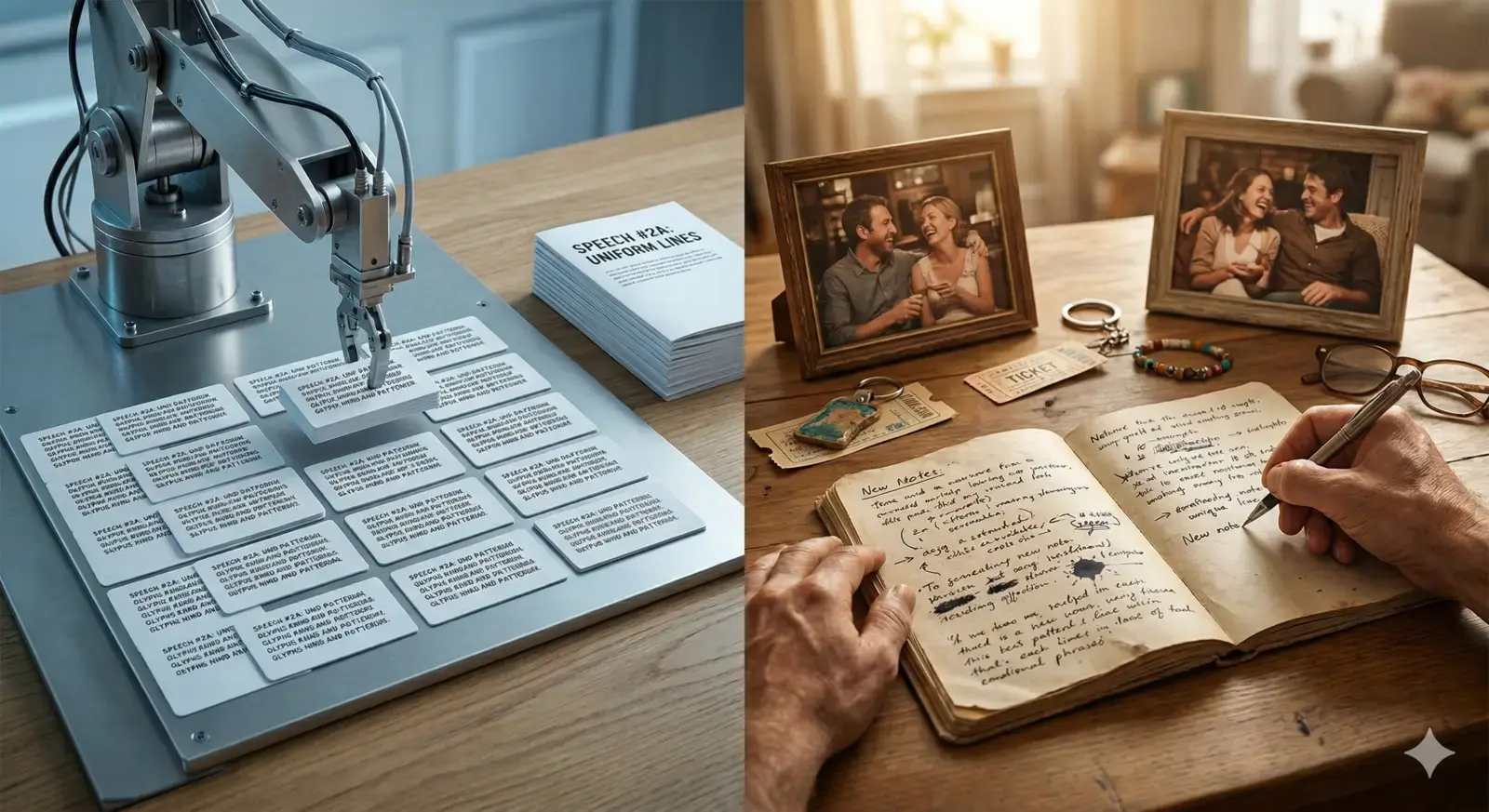
You've seen the Reddit threads. Someone admits they used ChatGPT for their best man speech and the comments pile on: "That sounds like a Hallmark card." "You could swap any name in and it still works." "That's not a speech, it's a template with pronouns."
And honestly? They're right. Most AI wedding speeches do sound generic. But the problem isn't AI. The problem is what people feed it.
The generic input problem
Here's what usually happens. Someone opens ChatGPT, types "write a best man speech for my friend Jake who's marrying Sarah, they met at university and they're great together," and hits enter.
The AI does exactly what it's built to do. It produces the most statistically probable version of a best man speech based on that input. And because the input is thin and vague, the output is too.
You get lines like: "Sarah lights up every room she enters, and watching her grow into the beautiful person she is today has been a true honour."
Sweet. Inoffensive. Could be about literally anyone alive.
As AI Literacy Academy explains: "When you input generic requests, you get generic outputs." The AI isn't broken. It's faithfully reflecting what you gave it, which was nothing.
Semantic ablation: the reason AI smooths away the good bits
There's a technical name for what happens when AI "polishes" text. Researchers call it semantic ablation. It's the algorithmic erosion of interesting, specific, unusual language.
Basically: AI gravitates toward the statistical centre. It sees an unusual phrase, a vivid image, a hyper-specific detail, and treats it as noise, because it's rare in the training data. Then it swaps it out for something safer and blander. Your weird metaphor becomes a cliché. Your oddly specific detail becomes a generalisation.
This is exactly why AI speeches lack the things that actually make speeches work: the inside joke only ten people in the room get, the weirdly specific detail about burnt toast, the sentence that makes the couple look at each other and crack up.
Those things are statistically rare. And AI, left to its defaults, optimises them right out of existence.
Three reasons AI speeches miss
1. The inputs are generic. A two-sentence prompt gives the AI nothing personal to work with. No real stories. No specific moments. No voice.
2. The prompts are vague. "Write something heartfelt" isn't a brief. It's an invitation for the AI to produce the average of every heartfelt thing ever written online.
3. There's no personal voice. When you type instructions about someone, you're describing them at arm's length. You're not channelling the way you actually talk about them. The rhythm, the affection, the way you'd tell the story if you were three beers in at the pub.
Change the input, not the AI
People try to fix this at the output end. They edit, re-prompt, add "make it more personal." But the real fix is at the input.
When the input is your voice, the output is your story.
Think about the difference between typing "Jake and I have been friends since uni, he's a great guy" versus actually talking about Jake for three minutes. The time he drove four hours to help you move. The voicemail he left after your dad's funeral. The way he always orders for the table without asking and somehow gets it right.
One of those gives an AI something to work with. The other gives it nothing.
Try this. Record a two-minute voice note about a specific memory with the person. Don't plan it. Just talk. Then compare it to what you'd type in a text box.
The voice version will have ten times more real material in it.
Talk-first speech writing: a different approach entirely
Most AI speech tools ask you to fill in a form. "Enter your relationship to the couple. Enter a funny memory. Enter a heartfelt moment."
That's the wrong interface for something this personal. And people can spot the results a mile away.
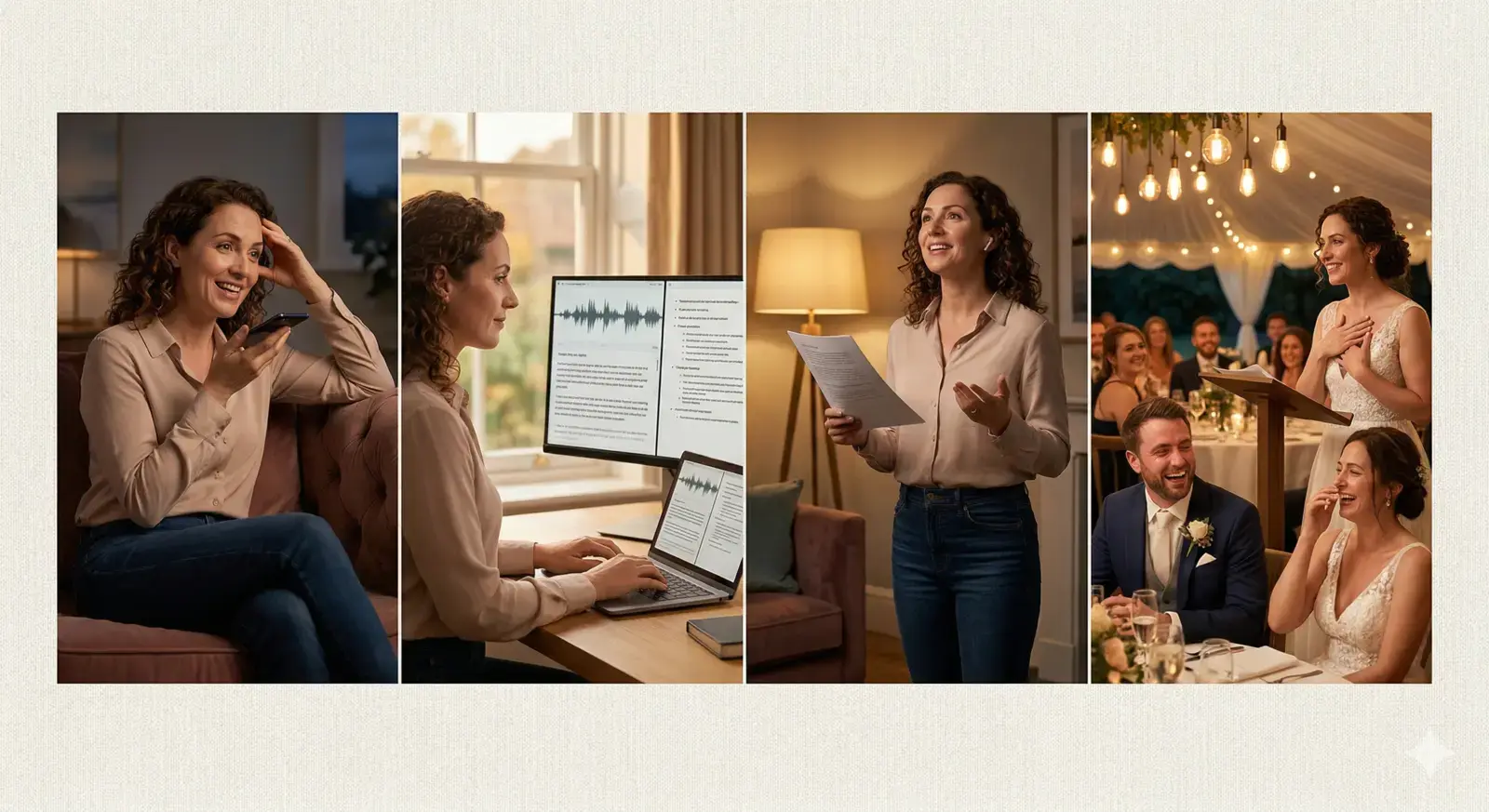
Talk-first speech writing works differently. You speak your memories, and the AI structures your actual words and stories into a speech. The input isn't a form. It's you.
That's what NailTheSpeech does. You talk, it listens, and the speech that comes back sounds like you. Because it is you. The AI shapes your material instead of generating from scratch.
The problem was never AI. It was asking you to type.
Ready to try talk-first speech writing?
Skip the blank page. Speak your memories and Nail The Speech will turn them into a speech that sounds like you.
Start Your SpeechNot ready to write yet? Grab the free 10-questions PDF to find your stories first.
Related Articles
Great speeches start with speaking
The only wedding speech generator that starts with your voice. Talk through your memories and get a speech you're proud to deliver.
Start Your Speech