Maid of Honor Speech Examples That Actually Work (Why They Land)
Three real maid of honor speeches from TikTok, broken down move by move.

Search "maid of honor speech examples" and you get two kinds of results. Template libraries full of fill-in-the-blank toasts that read like the inside of a greeting card. And TikTok clips of speeches that actually made the room laugh, then go quiet, then cheer.
The template ones are safe and forgettable. The TikTok ones are the reason a bride is still quoting her best friend's toast a decade later.
This article is about the second kind. We've pulled three real maid of honor speeches from TikTok and broken down exactly what each one is doing — which move it's pulling, the beat that tips it over the edge, and what you can steal for your own.
None of this is "just speak from the heart" advice. Every maid of honor speech that lands is doing something concrete. Once you can see the moves, you can use them.
Three things every great maid of honor speech gets right
Before the examples, the short version of what separates a toast the bride cries at from one the room politely claps through.
- Control of the tone. Earn the laughs first and you can take the room anywhere — emotional, and even back to funny. The speakers who land it own the wave instead of riding it.
- One sincere sentence. A single honest line about what the friendship actually is does more than a paragraph of lovely adjectives.
- The relationship you really have. Lifelong friend, sister, the person who's seen every era — the specific bond is the material. Lean into yours.
All three clips below are doing one of these better than almost anyone. Here's exactly how.
Example 1: Control the tone — funny, emotional, then funny again
What's happening. The videographer's caption tells the whole arc: Charlotte "had everyone laughing the whole way through, then just as it started to get emotional, she brought it back with a perfectly timed joke at the end." She doesn't just move from funny to sincere — she goes funny, lets it get emotional, then releases the room with one last joke.
Why it works. Most advice tells you to build to the emotional moment and end there. This does something harder and better: it earns the emotion, lands it, and then breaks the tension on purpose. That final joke isn't avoiding the feelings — it works precisely because the feelings already landed. The laugh lets the whole room exhale together instead of sitting in a heavy silence. It takes real control: you have to be willing to go to the sincere place, then trust yourself to walk the room back out.
The reason it reads as confidence is the timing. A joke a beat too early kills the emotional moment before it lands. A beat too late and the room's already welling up. Charlotte's caption-worthy "perfectly timed" is the whole skill — she let the sincere line breathe, then released it.
What to steal. If your speech is funny and you're scared of the emotional bit, don't skip it — plant it, land it, and write yourself an exit: one warm joke right after your most sincere line. You get the depth and you get to leave them smiling. Just hold the laugh until the sincere beat has actually landed.
Example 2: The one sincere line that says everything
What's happening. The whole clip is built around one sentence, and it's the line the creator pulled out as the caption: "No matter how busy life gets, I've never once doubted where I stand with her." That's the center of gravity of the entire speech.
Why it works. Compare that line to what most maid of honor speeches reach for — "she's my best friend, my person, my soulmate." Those are warm and they're weightless, because they could be said by anyone about anyone. This line is specific to a real friendship: the kind that doesn't need constant maintenance to stay solid. It names something true that everyone with a friend like that recognizes instantly. That's why it stops the room.
And notice what it doesn't do. There's no "okay, on a serious note" wind-up, no apology for getting emotional. It just says the thing, plainly. The lack of setup is what makes it land — the moment you announce a sincere line, you build a wall the line then has to climb over.
What to steal. Find the one true sentence about your friendship — not the grandest, the truest — and say it with no run-up. Strip every "but seriously" and every stacked adjective. One honest line, delivered straight, is the most powerful thing in any maid of honor speech.
Example 3: The sister's-eye view
What's happening. This one's a sister giving the maid of honor speech — "an absolute privilege to be my sister's Maid of Honour," as Bronach puts it. The whole speech is powered by a relationship a friend simply can't replicate: a shared childhood and a lifetime of being on each other's side.
Why it works. When the maid of honor is the bride's sister, the speech has a depth that's almost unfair. You don't have to establish that you know her — everyone already knows you've watched her grow up. So instead of proving the bond, you get to draw on it: the version of her only family remembers, the years no friend was there for, the particular way siblings love each other. That history is the most specific material in the room, and specific is what makes a speech feel like it could only have been given by you.
The trap for a sister isn't finding material — it's that the bond is so obvious it can tip into generic ("you've always been my best friend"). The ones that land stay concrete: a real childhood scene, a particular memory, the moment she knew her sister had found the right person.
What to steal. If you're the sister — or any maid of honor with a lifetime of history — lean all the way into it. Don't summarize the relationship; pick one moment from the years only you were there for. The closer the bond, the more the room wants the specific story, not the headline.
The reusable framework
Pattern-match across the three and the craft of a maid of honor speech reduces to three pillars:
- Own the tone, don't just ride it. Earn the laughs, let it get emotional, and you can even land a final joke to walk the room back out. Control is the skill — and timing is the control.
- Build it around one sincere sentence. Not a paragraph of praise — one specific, true line about the friendship, said with no setup. That's the beat the room remembers.
- Mine the relationship you actually have. Lifelong friend, sister, the person who saw every era — your specific history is the material. Pick one real moment from it, not the headline.
Everything else — the thank-yous, the "I've known her since we were five," the "I promise I'll keep this short" — is optional. Most speeches would be sharper without it.
What not to do (two common fails)
Fail 1: The adjective speech. A string of lovely-sounding qualities with no story underneath. "Kind, funny, beautiful inside and out, my person." It's warm and it's weightless. Fix: every quality you want to claim, prove with a scene instead of stating it.
Fail 2: The inside-joke marathon. Five minutes of references that the bride and three bridesmaids understand and the other 120 guests sit through politely. Fix: if a joke needs back-story to land, it belongs in your toast at the bachelorette, not this one.
A note on writing vs. talking your speech
One thing worth flagging. Watch those clips with the captions off and you'll notice they sound like someone talking, not reading — the rhythm of a story told to a friend, with pauses and warmth and the occasional self-correction.
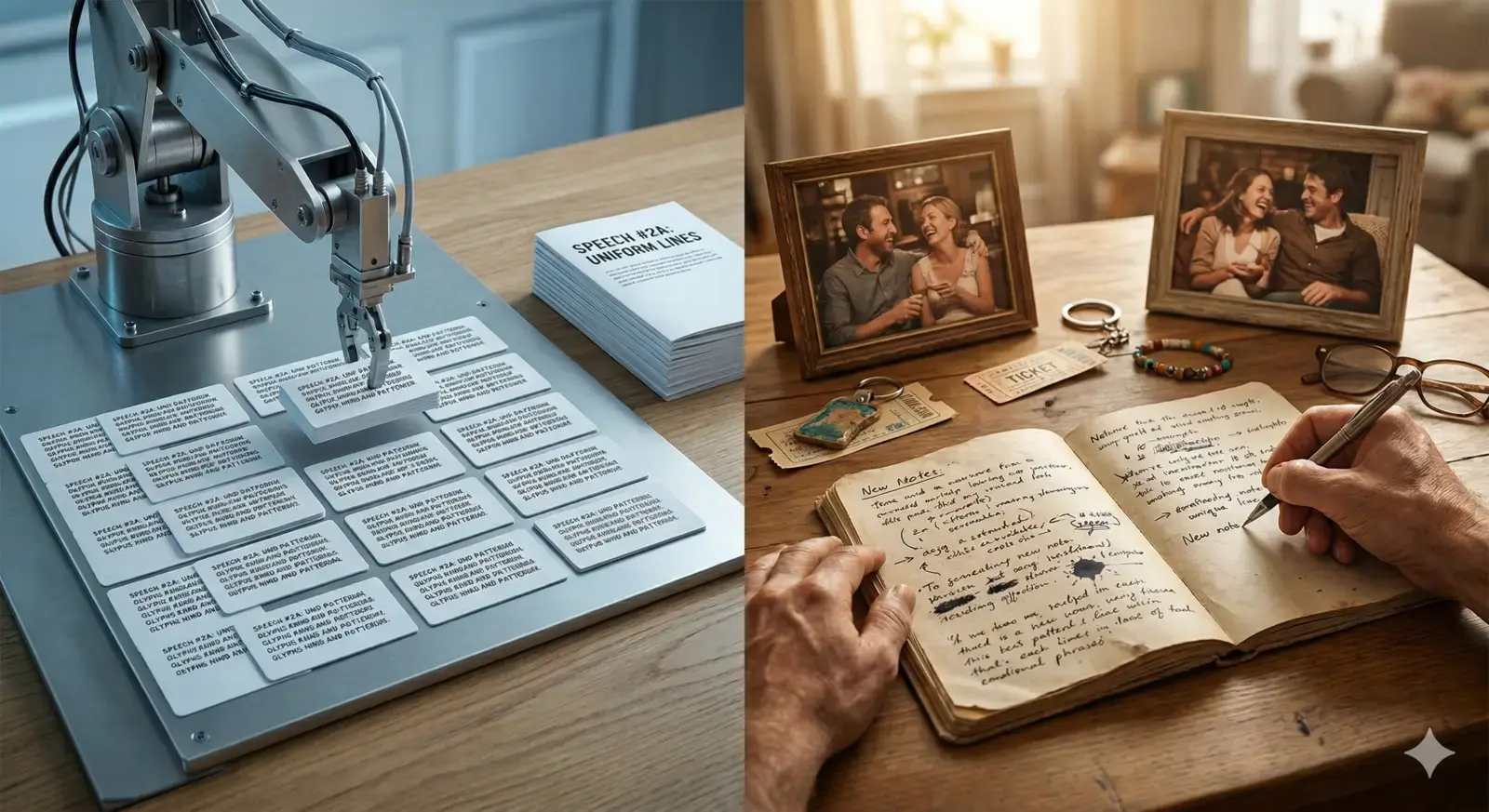
That's almost impossible to fake by typing at a blank page. Typing makes you sound like an email. It's one of the reasons most AI wedding speeches feel generic — they're built from typed prompts that were never going to sound like anyone's real voice.
If you want your speech to sound like you, start by speaking it. Record a voice note talking about the bride: the funny stuff, the one sincere thing you most want the room to know, the moment from your history together that says it all. Don't script it. Just talk. Then shape that into a speech — or let a tool built for exactly this job do the shaping for you.
Try this before you write a single line
Twenty minutes, no writing required. Open your phone's voice recorder and answer these three prompts out loud, one at a time:
- The funny and the feeling. Tell a story about the bride that makes you laugh — then say the sincere thing underneath it. Notice where the laugh could come back to release the room.
- The sincere line. Say the single truest sentence about your friendship. One line. No setup.
- The moment only you have. Tell one scene from your history together that a newer friend couldn't tell. The more specific, the better.
Stop recording. That's the spine of your speech. Everything else is runway.
When you're ready to turn it into something you can stand up and deliver, start with your voice, not a blank page.
Ready to try talk-first speech writing?
Skip the blank page. Speak your memories and Nail The Speech will turn them into a speech that sounds like you.
Start Your SpeechNot ready to write yet? Grab the free 10-questions PDF to find your stories first.
Related Articles
Great speeches start with speaking
The only wedding speech generator that starts with your voice. Talk through your memories and get a speech you're proud to deliver.
Start Your Speech